 EN
EN

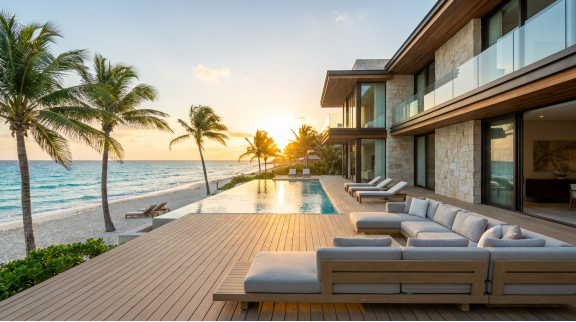
When specifying materials for a commercial project—be it a seaside resort in the Maldives, a rooftop bar in Mexico City, or a public boardwalk in Dubai—the initial purchase price is often a deceptive metric. For procurement managers and project owners, the question isn't "What does it cost today?" but rather "What will it cost over the next 10 to 25 years?"
In 2026, outdoor wpc flooring (Wood-Plastic Composite) has become the gold standard for high-traffic, exterior applications. However, many decision-makers still cling to traditional hardwoods like Ipe or Cedar, citing lower upfront material costs. At Hangzhou Feihuang Industry Co., Ltd. (Naturwing), we have been manufacturing WPC for 28 years (since 1998). Over nearly three decades, we have audited hundreds of projects and the data is conclusive: the Total Cost of Ownership (TCO) of WPC is significantly lower than wood. This article provides a comprehensive financial and technical breakdown of why composite is the rational choice for the 2026 commercial landscape.
1. The TCO Framework: More Than Just the Invoice
Total Cost of Ownership (TCO) is a financial estimate intended to help buyers determine the direct and indirect costs of a product. For outdoor flooring, the TCO formula includes:
- Initial Acquisition: Material cost + Shipping (FOB/CIF)
- Installation: Labor + Fasteners + Substructure (Joists)
- Maintenance: Annual cleaning + Sealing/Oiling + Sanding
- Replacement: Cost of board failures + Labor for localized repairs
- Disposal: The cost at the end of the product's life
While natural wood might have a lower "Initial Acquisition" cost (depending on the grade), its "Maintenance" and "Replacement" costs are exponentially higher. Our factory data from 40+ automated lines shows that Naturwing WPC achieves its "breakeven point" against premium hardwood in as little as 3.5 years.
2. Maintenance Realities: Wood Oiling vs. WPC Cleaning
Maintenance is the "silent profit killer" for commercial properties. A 500-square-meter hotel deck made of cedar requires professional sanding and oiling every 12-18 months to prevent rot and silvering.
|
Task |
Traditional Wood (Cedar/Pine) |
Outdoor WPC Flooring (Naturwing) |
|
Annual Cleaning |
Scrubbing + Pressure Washing |
Simple Soap & Water Rinse |
|
Sanding/Resurfacing |
Every 2-3 Years |
Never Required |
|
Staining/Oiling |
Every 1-2 Years |
Never Required |
|
Pest Control |
Periodic Termite Treatment |
Inherently Insect-Proof |
|
Board Replacement |
High (Due to warping/splitting) |
Very Low (High dimensional stability) |
|
Estimated Annual Cost |
$12 - $18 per m² |
$1 - $3 per m² |
By eliminating the need for chemicals, oils, and specialized labor, outdoor wpc flooring saves property owners thousands of dollars per decade. At our 28-year facility, we formulate our WPC with 30% high-density PE, which creates a moisture barrier that wood simply cannot match.
3. Lifecycle Comparison: The 25-Year Projection
Let’s look at a concrete example: A 1,000 m² commercial boardwalk project. We compare premium Grade-A Pine (pressure-treated) with Naturwing Co-extruded WPC.
Year 0 (Installation):
- Wood: $45,000 (Materials) + $20,000 (Labor) = $65,000
- WPC: $65,000 (Materials) + $15,000 (Labor - Easier with clip systems) = $80,000
- WPC is $15,000 more expensive on Day 1.
Year 5 (The Breakeven):
- Wood Maintenance: $15,000 (3 cycles of oiling/sanding) + $5,000 (Board repairs) = $20,000
- WPC Maintenance: $2,000 (Periodic cleaning) = $2,000
- Total Wood Cost: $85,000 | Total WPC Cost: $82,000.
Year 15 (The Divergence):
- Wood: Requires a full structural replacement due to internal rot. Cost: $70,000.
- WPC: Still structurally sound, color maintains 90% of original vibrancy (ΔE < 5).
- Total Wood Cost: $195,000+ | Total WPC Cost: $95,000.
By Year 25, the outdoor wpc flooring has saved the owner over $100,000—more than the original cost of the entire project. This is why our 40+ automated production lines are constantly busy fulfilling orders for repeat commercial clients who have seen these numbers play out in real life.
4. Engineering for Durability: The Naturwing Standard
The reason our TCO projections are so reliable is rooted in our manufacturing process. Founded in 1998, Hangzhou Feihuang (Naturwing) has perfected a high-density formula (1.35 g/cm³) that resists the "Big Three" killers of outdoor flooring:
- UV Degradation: We use premium UV-stabilizers that pass the ASTM G155 test with flying colors.
- Moisture Ingress: Our water absorption rate is ≤ 0.5% (24h immersion), whereas wood can absorb up to 50% of its weight in water, leading to the expansion that causes splitting.
- Mechanical Stress: Our boards are tested for a Modulus of Rupture (MOR) of ≥ 25 MPa, ensuring they can handle the heavy foot traffic of public parks and busy restaurants.
We offer Low MOQ (100㎡) and 7-Day Fast Shipping on samples because we want architects to see and feel this density before they commit to a 25-year specification.
5. Environmental Impact: The Sustainable Financial Gain
In 2026, "Green Building" isn't just an ethical choice—it’s a financial one. Properties with LEED or BREEAM certifications command higher rents and higher resale values.
Our outdoor wpc flooring is composed of 95% recycled materials: 60% reclaimed wood fiber from the furniture industry and 35% recycled HDPE plastic (milk jugs and detergent bottles). By choosing WPC, you are not only saving on maintenance costs but also aligning your project with the global circular economy. Our products are Reach and SGS certified, ensuring they contain no toxic heavy metals that could leach into the soil—a common problem with chemical-treated pressure-pine.
6. Honest Negative: When is Wood Irreplaceable?
Despite our 28 years in the WPC business, we recognize that wood still has its place. We recommend against WPC in the following specific scenarios:
- Historical Restorations: If a project requires "period-correct" materials for a 19th-century landmark, WPC—no matter how well-embossed—is not a suitable replacement for authentic timber.
- Structural Load-Bearing Beams: WPC is a flooring and cladding material. It lacks the longitudinal tensile strength of solid wood beams. Never use WPC as a primary structural support for a building.
- Intense Heat Reflection Areas: If your deck is situated directly in front of large, low-E glass windows that reflect a "hot spot" of concentrated sunlight (reaching 90°C+), WPC can soften and warp. In these "death ray" zones, natural stone or specific heat-resistant hardwoods are a safer bet.
7. Global Logistics & Sourcing: The 2026 Reality
Sourcing from a proven wpc manufacturer like Naturwing simplifies the global supply chain. We ship to 100+ countries, with a significant presence in North and South America.
- OEM/ODM Services: We can customize the thickness, width, and color of your flooring to meet specific regional building codes.
- Certified Quality: We hold CE, ISO 9001, and ASTM certifications, making our products easy to import into strictly regulated markets like the EU or Saudi Arabia (SABER/SASO).
- Capacity: With 40+ lines, we can produce a full 40'HQ container (approx. 800-900 m² of solid decking) in 15-20 days, ensuring your project timeline remains intact.
8. Conclusion: Making the Financially Sound Choice
The debate between outdoor wpc flooring and traditional wood is no longer just about aesthetics—it's about financial engineering. When you account for the 25-year TCO, the choice is clear. Wood is a high-liability material; WPC is a high-performance asset.
At Naturwing, we are ready to help you run the numbers for your next project. [Request a Free TCO Consultation & Sample Kit](https://www.naturwingwpc.com/contact). Let our 28 years of experience guide your next procurement decision.
Frequently Asked Questions
Q1: Does WPC flooring get hotter than wood in the sun? On average, dark-colored WPC can be 5-8°C warmer than light-colored wood. However, our lighter shades (Teak, Silver Grey) perform almost identically to natural timber. For pool areas, we recommend our co-extruded "Cool-Foot" technology which reflects a higher percentage of IR radiation.
Q2: Is WPC flooring slippery when wet? No. Our boards are embossed with deep wood-grain textures that provide a slip-resistance rating of R10 or R11. They are extensively used in pool decks and public boardwalks where safety is paramount.
Q3: Can WPC be installed with hidden fasteners? Yes. Unlike most wood which must be face-screwed (leaving holes that collect water and rot), our WPC flooring uses a hidden clip system. This allows for natural thermal expansion while providing a clean, screw-free surface.
Q4: How does the "7-Day Fast Shipping" work? For our most popular commercial colors and profiles kept in stock at our Hangzhou facility, we can have your order packed and ready for the port within 7 days. This is ideal for trial orders or topping up an existing project.
Q5: What certifications should I look for in a WPC manufacturer? Always demand ISO 9001 for factory management, CE (EN 15534) for European compliance, and ASTM (G155/B117) for UV and salt-spray resistance. Naturwing holds all of these and more.