 EN
EN
In the world of engineered building materials, 2026 marks a definitive shift. The era of "basic" Wood-Plastic Composite (WPC) is being eclipsed by a superior technological evolution: co-extrusion wpc (also known as Capped or Generation 3 WPC). While first-generation WPC solved many of the rotting issues associated with natural wood, it still faced challenges with color fading, oil staining, and surface mold in extreme climates.
At Hangzhou Feihuang Industry Co., Ltd. (Naturwing), we have been at the forefront of this transition. With 28 years of manufacturing history (since 1998) and a robust capacity of 40+ automated production lines, we have seen the market demand shift from cost-first to performance-first. This article explains the technical "why" behind co-extrusion technology and why it has become the non-negotiable standard for architects and developers working on premium hospitality, residential, and commercial projects globally.
1. What Exactly is Co-extrusion WPC?
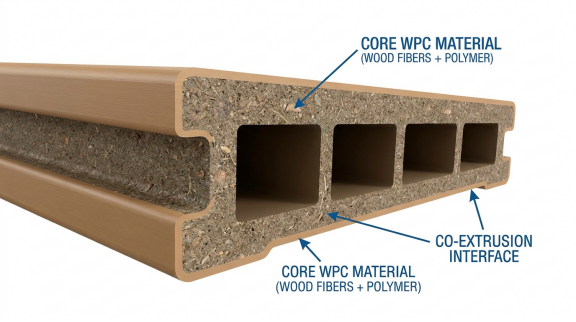
To understand co-extrusion wpc, one must look at it as a two-part system rather than a single material.
- The Core: This is the structural heart of the board, typically made of a dense mix of 60% wood fiber and 30% high-density polyethylene (HDPE). It provides the stiffness and load-bearing capacity.
- The Cap (Shield): This is a high-performance polymer layer that is "co-extruded" around the core during the same manufacturing process. It isn't a laminate or a coating; it is molecularly bonded to the core at high heat (approx. 190°C).
The result is a board that possesses the strength of a composite core with a surface that is virtually impermeable to the elements. Unlike Gen-1 WPC, which is porous and exposes wood fibers to the air, co-extruded boards are completely sealed. In our Hangzhou factory, we use specialized twin-screw extruders that manage the complex flow rates required to bond these two different materials seamlessly.
2. The Science of the "Capped" Layer: ASA vs PE Polymers
Not all co-extrusion caps are created equal. The industry generally utilizes two types of polymers for the protective shield:
- High-Density PE (HDPE) Caps: Great for flexibility and standard weather resistance. This is the most common "Gen-3" material.
- ASA (Acrylonitrile Styrene Acrylate) Caps: The gold standard. ASA is a high-performance resin used in the automotive and aerospace industries for its exceptional UV stability and impact resistance.
At Naturwing, our premium lines utilize an ASA-enhanced shell. This shell contains a high concentration of UV-absorbers and anti-oxidants. Testing under ASTM G155 (Xenon Arc exposure) shows that our co-extruded boards maintain a ΔE color change of less than 3.0 after 3,000 hours—a level of stability that uncapped WPC simply cannot achieve.
3. Performance Benefits: Why the Upgrade Matters
Why should an importer or a project manager pay the 20-30% premium for co-extrusion wpc? The benefits are tangible and measurable:
- Ultra-Low Water Absorption: Under the CE EN-15534 standard, our co-extruded boards show water absorption of ≤ 0.2% after 24-hour immersion. Uncapped boards can absorb 0.8% to 2.0%. This microscopic absorption rate means zero swelling or buckling in tropical monsoon conditions.
- Stain Resistance: Because the cap is non-porous, liquids like red wine, coffee, or barbecue grease cannot penetrate the board. They sit on the surface and can be wiped away with a damp cloth—a critical feature for restaurant patios.
- Scratch & Hardness: Our co-extruded shell achieves a pencil hardness of 2H or higher. This makes it suitable for high-traffic public areas where sand, heels, and furniture movement would quickly scuff uncapped materials.
- Realistic Aesthetics: The co-extrusion process allows for "multi-chromatic" color patterns and deep 3D embossing that mimics the variegated grain of exotic hardwoods like Ipe or Teak.
4. Technical Specifications: A Comparative Analysis
For technical specifiers, the following table highlights the performance gap between generations:
|
Technical Spec |
Gen-1 (Uncapped) WPC |
Gen-3 (Co-extrusion) WPC |
Benefit of Gen-3 |
|
Water Absorption (24h) |
1.2% - 2.5% |
≤ 0.3% |
Prevents rotting/swelling |
|
Color Fade (2000h UV) |
ΔE 8 - 15 (Visible) |
ΔE < 4 (Minimal) |
25-year color stability |
|
Stain Resistance |
Poor (Porous) |
Excellent (Sealed) |
Easy maintenance |
|
Mold/Algae Growth |
Possible (In wood fiber) |
None (Surface is polymer) |
Long-term hygiene |
|
Pencil Hardness |
HB - F |
2H - 3H |
Superior scratch resistance |
|
Warranty (Residential) |
10 - 15 Years |
25+ Years |
Higher ROI |
5. Manufacturing Excellence: The 40-Line Advantage
Manufacturing co-extrusion wpc is significantly more complex than standard WPC. It requires precise control of two different melt-streams. If the temperatures or pressures are slightly off, the cap will delaminate from the core—a catastrophic failure in the field.
Hangzhou Feihuang Industry Co., Ltd. (Naturwing) has invested in high-precision Italian and German-influenced extrusion technology. With 40+ automated lines, we dedicate 15 lines exclusively to co-extrusion production. This specialization allows our engineering team to maintain ISO 9001 quality standards across every batch. We also offer OEM/ODM services, allowing clients to customize the cap thickness (up to 1.5mm) and texture for specific regional requirements.
6. Market Trends: The Decline of Uncapped WPC in the West
In markets like North America, Western Europe, and the Middle East, uncapped WPC is rapidly becoming a "budget-only" material. Most high-end developers now mandate co-extruded specifications to avoid the costly warranty claims associated with the fading and staining of earlier generations.
Furthermore, with our Low MOQ (100㎡) and 7-Day Fast Shipping for samples, the barrier to entry for this premium technology has disappeared. Importers can now offer Gen-3 performance at a price point that was previously reserved for Gen-1 products, thanks to our manufacturing efficiencies in Hangzhou.
7. Honest Negative: What are the Downsides?
As a transparent manufacturer, we must note that co-extrusion is not a "magic bullet" for every scenario:
- Initial Cost: The material cost of co-extruded WPC is typically 25% higher than uncapped boards due to the expensive polymer resins (ASA/HDPE) used in the shell.
- Edge Sealing: When a co-extruded board is cut to length, the core is exposed at the ends. In extremely wet environments, these cut ends must be sealed with a color-matched end-cap or a silicone-based sealer to prevent moisture ingress into the core.
- Heat Retention: Because the surface is a solid polymer, dark-colored co-extruded boards can retain more heat in direct summer sun than porous uncapped boards. We always recommend light-to-medium colors for poolside applications.
8. Conclusion: Future-Proofing with Naturwing
If you are planning a project that needs to look as good in 2040 as it does today, co-extrusion wpc is the only choice. It offers the ultimate defense against the harsh realities of the outdoor environment.
By choosing Naturwing, you are choosing 28 years of engineering heritage and the peace of mind that comes with SGS, CE, and ASTM certified materials. [Request a Technical Whitepaper & Co-extrusion Sample Kit](https://www.naturwingwpc.com/contact). Let our team show you why our Gen-3 technology is the backbone of premium projects across 100+ countries.
Frequently Asked Questions
Q1: Does the co-extruded cap ever peel or delaminate? If manufactured correctly, no. At Naturwing, the core and cap are extruded through a single die while both are in a molten state, creating a molecular bond. We have never had a reported case of delamination in 28 years of operation.
Q2: Can co-extrusion WPC be used for wall cladding as well as decking? Yes. In fact, co-extrusion is even more critical for wall cladding where aesthetics (color stability) are the primary goal. Our co-extruded cladding lines are among our most popular exports to the Mexican and Middle Eastern markets.
Q3: How do I clean co-extrusion WPC? Maintenance is incredibly simple. A periodic rinse with soap and water is all that is required. For stubborn dirt, a soft-bristled brush will remove surface debris without scratching the 2H-hard shell.
Q4: Is the material recyclable? Yes. Despite being a multi-material product, our co-extrusion WPC is 100% recyclable at the end of its lifespan. It is also Reach and SGS certified for environmental safety.
Q5: What is the lead time for co-extrusion orders? Because we operate 40+ lines, we maintain a standard lead time of 20-25 days for full container orders. For trial orders, we can often ship within 7-14 days.