 EN
EN

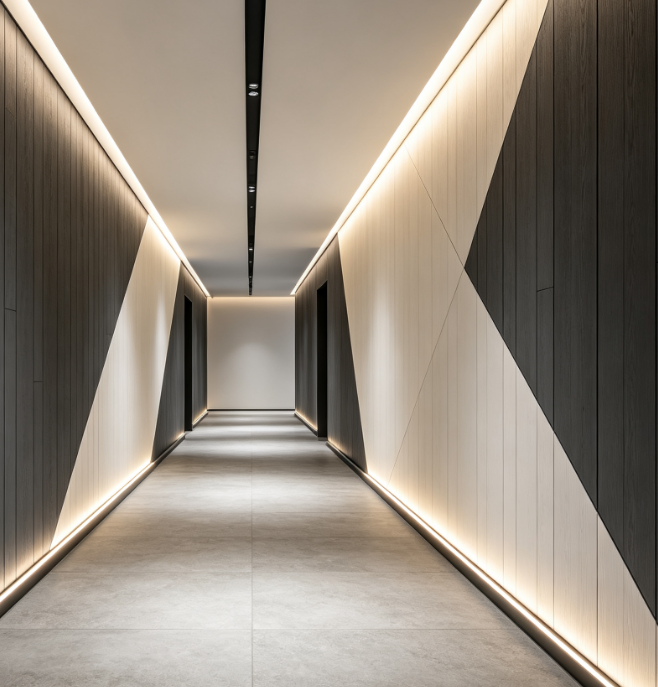
Introduction: For B2B buyers in the building materials sector, every step from "raising a requirement" to "confirming delivery" is filled with uncertainty. This article breaks down the complete closed-loop process of PVC wall panel procurement — from defining requirements to supplier verification and quality confirmation — through a real purchasing case study.
Case Background: A Typical B2B Procurement Scenario
In early July 2026, LuxBuild GmbH, a mid-sized building materials distributor headquartered in Berlin, Germany, initiated a new round of procurement. They needed to source PVC wall panels for two key projects in the second half of the year: an office building renovation in Frankfurt and a new commercial complex project in Munich.
Initial Requirements:
1. Product Type: PVC wall panels (interior use)
2. Quantity: Approximately 6,000 square meters
3. Requirements: Moisture-resistant, flame-retardant (Class B1), multiple color options
4. Target Price: Competitive wholesale pricing
5. Delivery: Before mid-September
On the surface, this appeared to be a fairly standard set of requirements. But Anna Becker, the procurement manager, knew well that the real challenges never appear on the requirements list — they lie beyond it.
"Many times, when a client says 'I need PVC wall panels,' what they actually need is 'a wall covering material that passes German building regulations and maintains its appearance for over 5 years in high-traffic office areas.'”
—— Anna Becker, Procurement Manager, LuxBuild GmbH
Phase 1: Requirement Breakdown & Supplier Pre-Screening
Before sending out inquiries, Anna spent three days communicating with the project team to break down the initial requirements into specific, verifiable technical specifications:
1. Moisture Resistance: Originally described as "moisture-resistant" — broken down to water absorption ≤3% (after 24-hour immersion)
2. Flame Retardancy: Originally described as "Class B1" — broken down to DIN 4102 B1 certification with test report
3. Color Consistency: Originally described as "uniform color" — broken down to batch-to-batch color difference ΔE ≤1.5
4. Delivery Timeline: Originally described as "before mid-September" — broken down to production completed by August 15, arrived at port by September 5
Pre-Screening Results: Through Alibaba International Station and industry channels, Anna shortlisted 6 potential suppliers — 3 from Shandong, 2 from Zhejiang, and 1 from Guangdong.
Phase 2: Supplier Evaluation & Sample Verification
2.1 Supplier Evaluation Matrix
Anna adopted a multi-dimensional evaluation framework, looking beyond price to assess operational reliability, responsiveness, and customization capabilities:
1. Product Quality (Sample Testing) — Weight: 35% — Evaluated through physical sample inspection
2. Delivery Reliability — Weight: 25% — Evaluated through transaction records and customer reviews
3. Communication Response Speed — Weight: 15% — Evaluated through inquiry response time testing
4. Certifications & Compliance — Weight: 15% — Evaluated through verification of ISO/CE/SGS certifications
5. Price Competitiveness — Weight: 10% — Evaluated through quote comparison
2.2 Sample Testing is the Critical Step
Anna sent inquiries to three Shandong suppliers and one Zhejiang supplier, requesting samples. Two Shandong suppliers (Supplier A and Supplier B) responded within 72 hours and arranged sample shipments, with Supplier A providing free samples.
Sample Test Results:
1. Thickness Tolerance — Supplier A: ±0.05mm (Passed) — Supplier B: ±0.12mm (Failed, standard ≤±0.1mm)
2. Surface Hardness (Pencil Hardness) — Supplier A: 2H (Passed) — Supplier B: HB (Failed, standard ≥H)
3. Water Absorption (24h) — Supplier A: 2.1% (Passed) — Supplier B: 3.8% (Failed, standard ≤3%)
4. Color Difference (within batch) — Supplier A: ΔE=0.8 (Passed) — Supplier B: ΔE=1.2 (Passed, standard ≤1.5)
5. Flame Retardancy (DIN 4102 B1) — Supplier A: Passed with report — Supplier B: Report not provided
Supplier A passed all tests with stable sample quality and complete documentation. Supplier B fell short on water absorption and flame retardancy certification, and was placed on the backup list.
"The gap between sample quality and bulk delivery is every buyer's biggest fear. Perfect samples but substandard bulk — I've seen this too many times."
—— Anna Becker
Phase 3: Factory Verification & Production Monitoring
3.1 Video Factory Audit
Due to time constraints, Anna could not visit China in person for a factory inspection. She requested Supplier A to arrange a real-time video factory tour, focusing on four key areas:
1. Raw Material Warehouse: Confirmed adequate PVC resin and additive inventory with a stable supply chain
2. Production Line: Assessed automation levels and confirmed monthly capacity could meet the 6,000 sqm delivery timeline
3. Quality Control Stations: Reviewed in-line testing equipment and confirmed the existence of in-process quality control procedures
4. Finished Goods Packaging Area: Verified export packaging standards and moisture protection measures
3.2 Clear Deliverable Requirements
Anna specified a complete list of deliverables in the contract with Supplier A:
1. Product Specification Sheet (TDS) — Delivered after contract signing
2. Certificate of Analysis (CoA) — Delivered with each batch
3. B1 Flame Retardancy Certificate Copy — Delivered before shipment
4. Batch Traceability Records — Delivered with shipment
5. Certificate of Origin — Delivered with shipment
The value of this documentation package was clear: **Anna no longer had to rely on gut feeling to assess quality — she could present a complete set of written, verifiable evidence to her clients proving that "this batch meets the standards."
Phase 4: Results & Delivery
Final Outcome:
1. Supplier A completed production of 6,000 square meters on August 12 (3 days ahead of schedule)
2. Third-party SGS pre-shipment inspection: All passed
3. Goods arrived at Hamburg Port on September 3 (2 days ahead of schedule)
4. Frankfurt office project started on time
Anna's Summary:
"What satisfied me most about this procurement wasn't the price — it was the predictability of the entire process. From requirement breakdown to sample testing, from factory video audit to pre-shipment inspection, every step had clear standards and verifiable evidence. No surprises, no unexpected issues — that's exactly what I expect from a supplier."
Key Takeaways
Advice for Buyers
1. Break down requirements — Don't just say "good quality" — specify measurable standards like "water absorption ≤3%, color difference ΔE≤1.5"
2. Test samples yourself — Don't just look at appearance — measure actual performance against your standards
3. Verify factories remotely — Video factory tours are the minimum safeguard for remote international procurement
4. Secure complete documentation — TDS, CoA, test reports — none can be missing from your checklist
5. Engage third-party inspection — For critical orders, a few hundred dollars for SGS pre-shipment inspection is a worthwhile investment
Lessons for Suppliers
1. Sample = Business Card — Sample quality directly determines whether buyers will proceed to the next round of evaluation
2. Data = Trust — Providing real test data is far more convincing than simply saying "good quality"
3. Transparency = Deal Closed — Suppliers willing to accept video factory tours have significantly higher conversion rates
4. Documentation = Moat — Suppliers who can provide complete delivery documentation build stronger client loyalty and repeat business
Conclusion
A successful B2B procurement is essentially a transformation process from uncertainty to certainty.
Buyers start with vague requirements, pass through supplier screening, sample verification, factory auditing, and documentation confirmation, and ultimately arrive at a predictable, verifiable delivery outcome. Each step eliminates uncertainty — and that is precisely the value of professional procurement.
For B2B buyers of PVC wall panels, this case study provides a practical framework for action: Don't just ask "how much," but ask "how do you prove you're worth that price."
About Naturewing: As a manufacturer with over 10 years of experience in WPC and PVC panel production, Naturewing offers full in-house manufacturing, CE/SGS/ISO 9001 certifications, 15-25 day lead times, and complete test reports with batch traceability documentation. For more product information or sample requests, please contact us.