 EN
EN

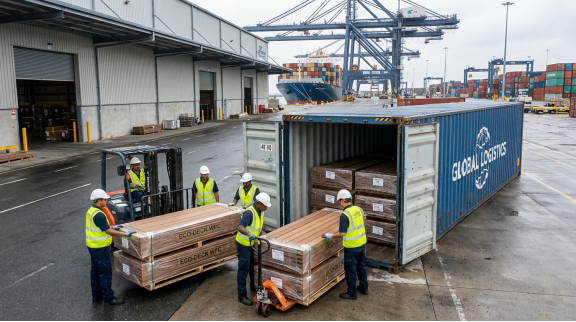
Introduction: Why Loading Strategy Defines Your Profit Margin
In the global building materials trade, the product cost is only one part of the equation. For WPC (Wood Plastic Composite) decking and cladding, sea freight and local trucking can account for 15% to 30% of the final landed cost. If your container is under-loaded by just 10%, your profit margin can evaporate. Conversely, over-loading can lead to port fines, damaged goods, and rejected shipments.
WPC is a "heavy" material (density ≥ 1.3 g/cm³). Unlike lightweight insulation or furniture, WPC containers typically "weight out" before they "cube out." This means the maximum payload weight of the container is reached before the physical space is full.
Knowing wpc container loading best practices is essential for any professional importer. This guide provides the actual loading data for 20'GP and 40'HQ containers based on our 28 years of shipping experience at Naturwing (Hangzhou Feihuang Industry Co., Ltd.).
The Real Data: 20'GP vs. 40'HQ Capacity
These figures are based on a standard co-extrusion hollow decking board (138mm x 23mm, 2.9m length). Actual numbers will vary slightly based on your specific profile and board length.
|
Container Type |
Max Payload Weight |
Est. Linear Meters |
Est. Square Meters (㎡) |
Pallet Count |
|
20' GP (General Purpose) |
~21,000 - 24,000 kg |
~3,500 - 4,000 m |
~480 - 550 ㎡ |
8 - 10 Pallets |
|
40' HQ (High Cube) |
~26,000 - 28,000 kg |
~7,500 - 8,500 m |
~1,000 - 1,170 ㎡ |
12 - 14 Pallets |
Key Insight: You will notice that a 40'HQ has double the volume of a 20'GP, but only about 50-70% more weight capacity. This makes the 40'HQ the most cost-effective choice for long-distance ocean freight (like China to the UK or Brazil) because the "cost per square meter" of freight is significantly lower.
Weight Distribution and Palletization
WPC boards are usually packed on pallets. A standard pallet for 2.9m boards is approximately 2.9m long and 1.1m wide.
- Board Length Optimization: 2.9m is the "Golden Length" for containers. It allows for two pallets to sit end-to-end with just enough space for the container doors to close and for a forklift to maneuver. For 5.8m boards, you can only load one pallet deep, which can be harder to unload at the destination.
- Protection: Every Naturwing pallet is wrapped in moisture-proof PE film and secured with high-tensile PET strapping and cardboard edge protectors. This prevents the "shifting" that causes surface scratches during 30 days at sea.
Honest Negative: The Limits of Container Loading
We believe in radical transparency regarding the logistics of WPC:
- The "Last Pallet" Problem: Sometimes there is physical space for one more pallet, but the container weight limit has been reached. Do not ask your supplier to exceed the weight limit. Shipping lines can refuse to load the container at the port of Ningbo/Shanghai, or it can be stopped at the scales in the destination country, leading to massive fines.
- Top-Loading Risks: While it’s tempting to throw "loose boards" on top of the pallets to fill every gap, this makes manual unloading extremely dangerous and slow for your warehouse team.
- LCL Damage: If you are ordering Less than Container Load (LCL), your pallets will be mixed with other cargo (maybe heavy machinery or chemicals). The risk of damage is 3-4 times higher than with a dedicated Full Container Load (FCL).
Maximizing ROI: Mixing SKUs
The most efficient way to load a WPC container is a "Hybrid Load." Because decking is heavy and hollow, you can often fit lighter accessories into the "voids":
- Clips and Screws: These can be tucked into the gaps between pallets.
- Joists/Bearers: Aluminum or WPC joists can often be bundled and loaded on top of the decking pallets without exceeding the weight limit.
- Edge Trims (L-Profiles): These are light and can be placed along the sides of the container.
At Naturwing, our logistics team provides a 3D Loading Map for every 40'HQ order, showing exactly where each SKU is located for easy unloading.
Port Considerations: 20' vs 40'
- US Markets: Many US states have strict road weight limits. Even if a 40'HQ can hold 28,000kg, you might only be allowed to carry 20,000kg on a truck from the port to your warehouse. In the US, 20' containers are often more popular for inland deliveries.
- UK/European Markets: 40'HQ is the standard. Most European ports and trucking networks are optimized for the higher weight of a full 40'HQ.
Why Naturwing's Logistics Team is Your Secret Weapon
Hangzhou Feihuang Industry Co., Ltd. (Naturwing) has 28 years of export experience. We don't just "fill a box." We optimize your supply chain.
- 40+ Automated Lines: We can synchronize production to ensure all items for a multi-SKU container are ready at the same time, avoiding split-shipment costs.
- VGM Verification: We provide accurate Verified Gross Mass (VGM) data to avoid port delays.
- Loading Photos: We send a full report of 10+ photos of your container being loaded, including the seal number, so you have evidence for your insurance and customs.
Frequently Asked Questions
Q1: How many square meters of 138x23mm decking fit in a 20' container? Typically between 480㎡ and 550㎡ depending on the board weight and the specific weight limit of the shipping line you choose.
Q2: What is the maximum weight I can put in a 40'HQ? Most shipping lines allow up to 26,500kg of cargo, but some "Heavy Tested" containers can take up to 28,500kg. Always check with your freight forwarder first.
Q3: Can I load 5.8 meter long boards? Yes, but you must use a 40' container. Loading and unloading 5.8m pallets requires a long-reach forklift or a "side-loader."
Q4: How do I calculate the 'Landed Cost' per square meter? (FOB Price + Sea Freight + Insurance + Customs Duty + Port Fees + Inland Trucking) / Total Square Meters in the container.
Q5: Why is my 40'HQ only 70% full by volume? Because WPC is dense. The container reached its weight limit (27 tons) before it ran out of air space. This is normal for building materials like WPC, tiles, and stone.