 EN
EN

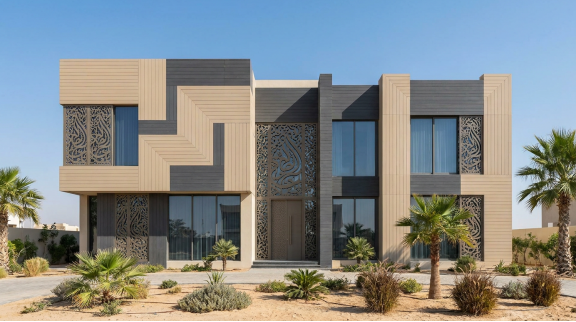
Architects and developers in the Gulf Cooperation Council (GCC) countries face a unique set of challenges when selecting exterior wall materials. The Middle East environment is one of the most punishing on the planet: sustained summer temperatures exceeding 50°C, extreme UV indices reaching 11+, sandstorms that act like industrial abrasives, and high humidity in coastal cities like Dubai, Jeddah, and Muscat.
Traditional wood cladding fails within seasons under these conditions, requiring constant oiling and eventually rotting or cracking. While aluminum and stone are popular, many premium villa projects in Riyadh and Abu Dhabi now demand the warmth and texture of natural wood without the catastrophic maintenance overhead. This is where high-performance composite cladding in the Middle East has become the gold standard.
However, not all WPC (Wood Plastic Composite) is created equal. For a Middle East villa, the "standard" WPC used in Europe or North America will likely fail. This article provides the technical spec sheet and sourcing framework that GCC architects need to ensure long-term structural and aesthetic integrity.
The Middle East "Desert Spec": Essential Technical Requirements
When specifying composite cladding for projects in the UAE or Saudi Arabia, the technical data sheet (TDS) is more important than the marketing brochure. Here is the minimum "Desert Spec" architects should demand:
|
Property |
Requirement for GCC |
Standard |
|
UV Resistance |
ΔE ≤ 5 after 2,000 hours |
ASTM G155 |
|
Heat Deflection Temp |
≥ 85°C |
ASTM D648 |
|
Linear Expansion |
≤ 0.3% (at 20°C to 80°C delta) |
EN 15534 |
|
Fire Rating |
B1-s1, d0 (Flame Retardant) |
EN 13501-1 |
|
Water Absorption |
≤ 0.5% |
ASTM D1037 |
|
Hardness |
≥ 60 (Shore D) |
ASTM D2240 |
At Naturwing (Hangzhou Feihuang Industry Co., Ltd.), we have spent over 28 years refining our formulations for extreme climates. Our Gen-3 co-extrusion cladding is engineered specifically with an enhanced UV-inhibitor package that reflects thermal radiation, keeping the core material cooler and preventing the "banana effect" (warping) common in lower-grade products.
Co-Extrusion vs. First-Generation Cladding: A Critical Choice
In the Middle East, the choice between traditional WPC and co-extrusion WPC is not a matter of budget—it is a matter of survival.
First-Generation (Uncapped) WPC: This material has no protective outer shell. In the Dubai sun, the wood fibers on the surface are exposed directly to UV rays, leading to rapid "graying" and surface chalking within 12-18 months. Furthermore, the exposed fibers can absorb moisture during the humid months, leading to mold spots.
Gen-3 Co-Extrusion Cladding: This features a 360-degree protective PE (Polyethylene) shield that is extruded simultaneously with the core. This shield is non-porous and contains the bulk of the color pigments and UV stabilizers. For Middle East villas, co-extrusion is the only architect-recommended choice because it maintains color vibrancy and structural density for 20+ years.
Honest Negative: Where Composite Cladding Is NOT the Answer
While we champion WPC, E-E-A-T (Experience, Expertise, Authoritativeness, and Trustworthiness) requires us to be honest about its limitations. You should not specify composite cladding in the following scenarios:
- Structural Load-Bearing: WPC is a decorative and protective skin, not a structural material. It cannot be used as a primary support beam or column for a villa.
- Ultra-High Fire Risk Zones: While our material is B1-rated (flame retardant), it is not A1 (non-combustible) like solid stone or fiber cement. For high-rise buildings (above 15-20 meters) in certain GCC jurisdictions, local civil defense codes may require non-combustible A1 materials. Always check local UAE or KSA civil defense regulations for skyscrapers.
- Direct Contact with Intense Heat Sources: If the cladding is installed within 1 meter of a high-output outdoor grill or fire pit without proper shielding, the localized heat can exceed the heat deflection temperature (85°C), causing deformation.
Installation Best Practices for High-Expansion Environments
The Middle East experiences significant diurnal temperature swings (the difference between day and night temperatures). In Riyadh, this can be a 30°C difference. This causes materials to expand and contract.
- Expansion Gaps: Architects must ensure contractors leave a 3-5mm gap between the butt-ends of cladding boards. Without this, the boards will buckle when the sun hits them.
- Joist Spacing: For wall cladding, joists (sub-frames) should be spaced no further than 300-400mm apart. Using aluminum joists is highly recommended in the Middle East as they share a similar expansion coefficient with the cladding and won't rot like timber sub-frames.
- Hidden Fasteners: Use stainless steel (304 or 316 grade) clips. Plastic clips will degrade in the intense heat and eventually snap, causing the cladding to detach.
Why Naturwing is the Preferred Partner for GCC Developers
Hangzhou Feihuang Industry Co., Ltd. (Naturwing) has been a consistent supplier to the Middle East for over a decade. With 40+ automated production lines, we have the capacity to handle large-scale residential developments in Neom or luxury hotel projects on the Palm Jumeirah.
Our "Middle East Package" includes:
- Low MOQ: We support boutique villa projects with starting orders as low as 100㎡.
- Fast Samples: 7-day courier delivery to Dubai, Riyadh, or Doha so architects can verify the texture and color under local light.
- Compliance: Full certification including ASTM, CE, and ISO9001, ensuring your project passes municipal inspections.
Frequently Asked Questions
Q1: Does composite cladding fade in the Saudi Arabian sun? All materials undergo some UV adjustment, but our co-extrusion cladding is limited to a ΔE ≤ 5 over 2,000 hours of accelerated weathering. In practical terms, the color remains stable and rich for decades, unlike natural timber which turns grey in months.
Q2: Can I install WPC cladding on a curved villa wall? Yes, but only with specific profiles. Our thinner "Great Wall" or fluted profiles can accommodate a slight radius. For tight curves, we recommend a vertical installation pattern which is more flexible.
Q3: How do I clean sand and dust from the cladding after a storm? Because co-extrusion cladding is non-porous, a simple low-pressure power wash or a garden hose with mild soap is sufficient. There is no need for sanding or re-staining.
Q4: Is the material termite-proof? Yes. One of the primary reasons for the shift to WPC in the Middle East is that it is 100% resistant to termites and other wood-boring insects common in the region.
Q5: What is the lead time for a project in Doha, Qatar? Standard production takes 15-20 days. Shipping from Ningbo/Shanghai to Hamad Port typically takes 22-28 days. Total lead time is approximately 6-7 weeks.
Conclusion & Next Step
Composite cladding is no longer a "luxury alternative" in the Middle East; it is a technical necessity for architects who value longevity and low maintenance. By selecting a co-extrusion spec with a B1 fire rating and high heat deflection, you ensure that your villa project remains as stunning in 2036 as it is on handover day.
Ready to spec Naturwing for your next GCC project? Contact our Middle East account team for a technical data sheet and a free sample kit.