 EN
EN

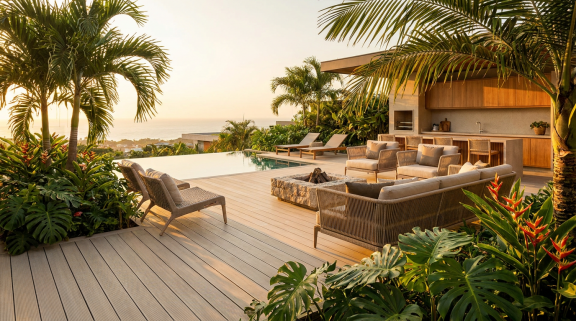
Introduction: The Rising Demand for WPC in the Brazilian Market
The Brazilian outdoor living market has shifted significantly over the last decade. Historically, Brazil relied on its abundant tropical hardwoods like Cumaru and Ipe. However, rising environmental regulations, the soaring cost of premium timber, and the high maintenance required in humid coastal climates like Salvador or Recife have pushed architects toward WPC (Wood Plastic Composite).
Importing composite decking to Brazil (madeira plástica) is a lucrative but complex venture. Between the "Custo Brasil" (Brazil Cost), fluctuating exchange rates (BRL), and stringent fiscal requirements, importers need more than just a product—they need a technical partnership with a factory that understands Mercosur logistics.
As a manufacturer with 28 years of experience, Hangzhou Feihuang Industry Co., Ltd. (Naturwing) has supplied hundreds of containers to the Brazilian market, specifically targeting the high-end residential sectors in São Paulo and Curitiba. This guide breaks down the essential steps for a successful "China-to-Brazil" import strategy.
Understanding NCM Codes and Import Taxes for WPC
Classification is the first hurdle in the Brazilian import process. Misclassifying WPC can lead to heavy fines from Receita Federal. In Brazil, WPC decking is typically classified under the NCM (Nomenclatura Comum do Mercosul) system.
|
NCM Code |
Description |
General II (Import Tax) |
|
3918.90.00 |
Floor coverings of plastics (Other than PVC) |
~16% - 18% |
|
3925.90.90 |
Builders' ware of plastics, not elsewhere specified |
~14% - 16% |
The "Custo Brasil" Tax Breakdown: Importing to Brazil involves a "tax on tax" cascade. For a typical shipment arriving at the Port of Santos, the following taxes apply:
- II (Imposto de Importação): 16-18%.
- IPI (Imposto sobre Produtos Industrializados): 5% to 15%.
- PIS/COFINS-Importação: Combined rate of approximately 9.25% to 11.75%.
- ICMS (State Tax): Varies by state. In São Paulo, it is typically 18%; in Santa Catarina, it can be lower due to special tax regimes (TTD).
- AFRMM: 8% of the international ocean freight (for maritime transport).
Pro Tip: Always work with a "Despachante Aduaneiro" (customs broker) to calculate the landed cost. Naturwing provides detailed Packing Lists and Commercial Invoices that align with Brazilian SISCOMEX requirements to ensure smooth clearance.
Quality Standards & Norms: What Brazilian Architects Demand
While Brazil does not have a specific "WPC-only" compulsory INMETRO certification for residential use, large-scale commercial projects in Rio de Janeiro or Brasília often require compliance with international fire and safety standards.
Key Technical Specs to Verify:
- Fire Rating: Brazilian fire departments (Bombeiros) often look for EN 13501-1 Class B or C. Naturwing’s co-extrusion products meet the EU EN 13501-1 standard, making them suitable for high-traffic commercial zones.
- UV Resistance: Brazil has some of the highest UV indices in the world. Standard WPC will fade within 12 months. We recommend our Gen-3 Co-extrusion technology, which maintains a Color Change (ΔE) of ≤ 5 after 2,000 hours of accelerated weathering (ASTM G155).
- Water Absorption: In humid regions like the Amazon or coastal Recife, moisture is the enemy. Naturwing WPC features a water absorption rate of < 1%, far superior to traditional timber which can swell up to 10-15%.
Logistics: Shipping from China to Brazilian Ports
Logistics to South America is a marathon, not a sprint. The transit time from Shanghai or Ningbo to Brazil is among the longest in the global trade route.
- Main Ports: Santos (SP) is the primary gateway for the Southeast. Rio Grande (RS) and Itajaí (SC) are critical for the Southern furniture and construction hubs. Recife (PE) serves the growing Northeast resort market.
- Transit Time: Usually 35 to 50 days depending on the carrier (Maersk, MSC, or COSCO) and transshipment points (often via Singapore or Tangier).
- Container Loading: A 40'HQ container can hold approximately 800-900 square meters of WPC decking, depending on the profile (hollow vs. solid). At Naturwing, we use reinforced palletizing to prevent shifting during the long Atlantic crossing.
Honest Disadvantage: When NOT to Choose WPC for Brazil
At Naturwing, we believe in transparency. WPC is not a "magic bullet" for every Brazilian project.
- Extreme Heat Retentention: In the scorching 40°C+ summers of Cuiabá or Ribeirão Preto, dark-colored WPC can become hot to the touch. In these specific "full sun" areas, we recommend lighter shades or traditional stone.
- Structural Spans: WPC is not a structural material. It cannot be used for the primary beams of a balcony. It must be installed on a properly spaced sub-frame (joists).
- Initial Cost: Compared to low-grade local "pinus" (treated pine), the initial investment for high-quality co-extrusion WPC is 2-3 times higher. However, the ROI is realized after year 3 when maintenance costs for wood (sanding/oiling) would have otherwise spiked.
Why Naturwing is the Preferred Partner for Brazilian Importers
Since 1998, Hangzhou Feihuang Industry Co., Ltd. (Naturwing) has focused on the "Quality-Durability" balance. With 40+ automated production lines, we offer:
- Low MOQ (100㎡): Ideal for Brazilian boutique architecture firms or first-time importers testing the market.
- Fast Sampling: 7-day fast shipping for samples to São Paulo or Rio.
- OEM/ODM Capabilities: We can produce custom profiles or private-label packaging for established Brazilian brands.
- Documentary Expertise: We provide the exact documentation required for "Canal Verde" (Green Channel) clearance in Brazil.
Frequently Asked Questions
Q1: Qual o prazo médio para importar um contêiner da China para o Brasil? Total lead time is approximately 65-80 days (20 days production + 45 days sea freight + 10 days customs clearance). We recommend planning your inventory 3 months in advance.
Q2: Can I get WPC decking with a texture similar to Brazilian Cumaru? Yes. Naturwing offers a "Deep Embossed" 3D wood grain and a specific "Ipe/Cumaru" color palette designed specifically for the South American aesthetic preference.
Q3: Is there a trade agreement between China and Brazil that reduces tariffs? Currently, China and Brazil trade under MFN (Most Favored Nation) terms. There is no specific FTA that eliminates the 16% Import Tax (II), unlike the Chile-China FTA.
Q4: How does WPC handle the high humidity in the Northeast of Brazil (e.g., Fortaleza)? Because our WPC contains 30-35% HDPE (High-Density Polyethylene), it is virtually immune to rot, mold, and termite attacks, which are common issues for wood in coastal Ceará.
Q5: What is the warranty for Naturwing products in Brazil? We offer a 15-year residential warranty and a 10-year commercial warranty for our co-extrusion series, covering fading, staining, and structural integrity.
Conclusion & Next Step
Importing composite decking to Brazil is a strategic move for any building material distributor looking to capture the "Low Maintenance" trend. By navigating the NCM classifications and choosing a climate-rated product, you can offer a superior alternative to traditional hardwoods.
Ready to start your first trial order? Contact our LATAM sales desk for a landed-cost estimation and a free sample kit sent to your Brazilian office.