 EN
EN

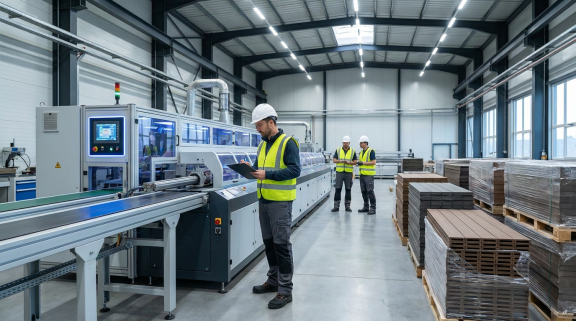
Introduction: The "Wild West" of WPC Manufacturing
The global Wood Plastic Composite (WPC) market is projected to reach USD 12.5 billion by 2030. This growth has triggered a surge in new "manufacturers" appearing on platforms like Alibaba and Made-in-China. However, the reality behind the polished photos is often different. In China alone, there are over 1,000 WPC factories, ranging from world-class automated facilities to small "backyard workshops" using recycled plastic of unknown origin and outdated machinery.
For a sourcing manager or a distributor, the stakes are high. A wrong choice doesn't just mean a late shipment—it can mean a total product failure (warping, fading, or crumbling) two years after installation, leading to massive warranty claims and brand destruction.
Knowing how to choose wpc manufacturer is about looking past the price list and the sample box. It’s about auditing the process and the integrity of the supplier. This guide provides 12 specific questions you must ask during a factory visit or a video audit, including what constitutes a "Good Answer" and what should be treated as a "Red Flag."
12 Factory Audit Questions: The Professional's Checklist
1. What is your ratio of virgin plastic to recycled plastic?
- Good Answer: "We use a precise blend of 60% wood fiber, 30% HDPE (High-Density Polyethylene), and 10% additives. We specify 'Grade A' recycled HDPE or a mix with virgin resin to ensure consistency."
- Red Flag: "We use 100% recycled plastic to save you money." (100% recycled plastic without strict sorting leads to structural instability and unpredictable expansion).
2. Do you mix your own raw materials (Compounding) or buy pre-mixed pellets?
- Good Answer: "We have our own compounding workshop. We control the formula, the UV stabilizers, and the coupling agents in-house."
- Red Flag: "We buy pre-mixed pellets from a third party." (This means they cannot adjust the formula for your specific climate—e.g., adding more UV inhibitors for the Middle East).
3. How many extrusion lines do you have, and are they twin-screw or single-screw?
- Good Answer: "We have 40+ twin-screw extrusion lines. Twin-screw machines provide better torque and more uniform mixing of the wood and plastic."
- Red Flag: "We have 5 single-screw lines." (Single-screw is slower and often results in a less homogeneous material, leading to internal weak spots).
4. Can you show me your "Boiling Test" records for today's production?
- Good Answer: "Yes, here are the logs. We boil samples from every batch for 2 hours (or up to 24 hours for premium lines) to check for internal bonding and water absorption."
- Red Flag: "We only do boiling tests once a month or when a customer asks." (Quality is a habit, not an event).
5. What brand of UV stabilizers and color pigments do you use?
- Good Answer: "我们 use international brands like BASF or high-end domestic equivalents with documented weathering data."
- Red Flag: "We use local generic pigments." (Generic pigments often fade within 12 months under high UV exposure).
6. How do you handle "Scrap" and "Regrind" from the factory floor?
- Good Answer: "We regrind our own clean production scrap and re-integrate it at a strictly controlled ratio (e.g., <5%) back into the core, never the surface layer."
- Red Flag: "We buy scrap from other factories to keep costs low." (External scrap can contain PVC or other contaminants that ruin HDPE-based WPC).
7. What is your tolerance for board thickness and width?
- Good Answer: "Our tolerance is +/- 0.5mm for thickness and width. We check this manually every 30 minutes and use inline laser sensors."
- Red Flag: "+/- 2.0mm." (High tolerances make installation a nightmare, with "steps" between boards).
8. Can you provide a "Delta E" (ΔE) report from a Xenon Arc Weathering test?
- Good Answer: "Yes, our co-extrusion products maintain a ΔE of less than 5.0 after 2,000 hours of ASTM G155 testing."
- Red Flag: "Our products don't fade." (All materials fade; a professional manufacturer knows exactly how much and has the data to prove it).
9. What is your "Low MOQ" policy for new colors or custom profiles?
- Good Answer: "We support new distributors with MOQs as low as 100㎡ for standard profiles and can discuss custom molds for orders over 500㎡."
- Red Flag: "Minimum 1 container (3,500㎡) per color." (This usually indicates a factory that is inflexible or a trading company that cannot break bulk).
10. Do you have a dedicated "After-Sales" or "Claims" protocol?
- Good Answer: "We have a written 25-year warranty and a claim process that requires photos and batch numbers. We respond within 48 hours."
- Red Flag: "We don't have claims because our quality is perfect." (This is a lie. Every factory has occasional issues; the good ones have a system to fix them).
11. Can I see the "Material Safety Data Sheets" (MSDS) for your additives?
- Good Answer: "Certainly. Our products are Reach and RoHS compliant, and we can provide the MSDS to prove they are lead-free and non-toxic."
- Red Flag: "We don't have those documents." (This is a major risk for importers in the EU or North America).
12. Are you a "Manufacturer" or a "Trading Company"? (The ultimate test)
- Good Answer: "We are the manufacturer (Hangzhou Feihuang Industry Co., Ltd.). You are welcome to visit our facility in Hangzhou anytime."
- Red Flag: "We are a factory group." (Often code for a trading company that outsources to multiple small shops).
Honest Negative: When a "Big Factory" Might NOT Be Your Best Choice
It sounds counterintuitive, but the biggest factory isn't always the right fit:
- Low Priority for Smaller Orders: If you are a mid-sized distributor, the "Top 3" giants might treat you as a low priority, leading to long lead times and slow communication.
- Rigidity: Huge factories often refuse to do custom color matching or OEM branding unless you are buying 20+ containers a month.
- Bureaucracy: If there is a quality issue, getting a resolution from a massive corporation can take months of internal "committee" meetings.
At Naturwing, we maintain a "Goldilocks" scale: 40+ lines—large enough to handle any project, but agile enough to offer 7-day fast shipping on samples and low MOQ flexibility.
Manufacturer Comparison Matrix
|
Feature |
Naturwing (Professional) |
Tier 1 Giant |
Tier 3 Workshop |
|
Response Time |
< 2 Hours |
24-48 Hours |
Varies |
|
MOQ |
100 ㎡ |
500+ ㎡ |
Low (but risky) |
|
Lab Testing |
Every batch |
Random |
None |
|
Custom Colors |
Yes (Free matching) |
High cost |
No |
|
Warranty |
20-30 Years |
25 Years |
5 Years (Oral) |
Why Naturwing Stands Out in Your Audit
Hangzhou Feihuang Industry Co., Ltd. (Naturwing) was established in 1998. With 28 years of experience, we have passed audits from some of the world's most demanding retailers and distributors.
- Transparency: We provide a live video tour of our 40+ lines anytime you request it.
- Certifications: We don't just "claim" compliance; we provide verified ASTM, CE, SGS, and ISO9001 reports.
- Innovation: Our Gen-3 co-extrusion technology was developed in-house to solve the "fading" problem seen in first-generation products.
Frequently Asked Questions
Q1: Can I hire a third party like SGS to audit your factory? Absolutely. We encourage it. We regularly host inspectors from SGS, Intertek, and Bureau Veritas on behalf of our international clients.
Q2: How do I know the production batch is the same quality as the sample? We keep "retainer samples" from every shipment for 3 years. If you find a discrepancy, we can test the retainer sample from that exact batch to verify the formulation.
Q3: What is the most important document in a WPC audit? The ISO9001 Certificate is the baseline, but the Xenon Arc Weathering Test Report (ASTM G155) is the most important for long-term product performance.
Q4: Do you offer OEM packaging for my brand? Yes. We provide full OEM/ODM services, including Spanish/French/Arabic labeled cartons and custom-branded protective film on the boards.
Q5: Why is your price slightly higher than some small workshops? Because we use 10% premium additives (UV stabilizers, coupling agents, antioxidants) which the workshops omit. Those additives are what keep your deck from failing in 2 years.
Conclusion & Next Step
Choosing a WPC manufacturer is a decision you will live with for 20 years. Don't be seduced by the lowest price or the flashiest website. Use these 12 questions to "dig into the dirt" and find a partner who values technical integrity as much as you do.