EN
EN

PVC Wall Panels Application Case for July 2026: Solving Budget, Capacity, Lead Time & Peak Season Preparation
Case Introduction
For building materials buyers, the months leading up to peak season are often the most stressful period. Budgets must be controlled, production capacity secured, and lead times guaranteed—and balancing all three can easily lead to project delays or cost overruns. This article walks through a real procurement case of a building materials distributor in the U.S. Midwest, demonstrating how strategic sourcing helped balance budget, capacity, and lead time pressures ahead of peak season.
Case Background
Client Profile:
A mid-sized building materials distributor headquartered in the U.S. Midwest, operating five warehouses and serving both residential and commercial construction clients. Primary purchases include PVC wall panels, WPC flooring, and related accessories.
Timeline:
Early July 2026, mid-peak season for North American construction (the local building season typically runs from April to October). Approximately 4-5 months remain before the year-end holiday season (Thanksgiving, Christmas), but procurement decisions must be made in July-August to ensure goods arrive on shelves before the holiday period.
Three Major Challenges Faced by the Client:
① Budget Pressure
PVC resin prices have continued to climb due to rising energy costs. According to the latest construction materials price index, the UK market saw a 5.4% year-on-year increase in the "All Work" materials price index as of May 2026, with manufacturers continuing to report rising input costs. While PVC price increases in China have been relatively moderate, peak-season demand has driven up overall procurement costs.
② Capacity Bottlenecks
July coincides with the peak period for Chinese factories taking Q3 orders. One Vietnamese building materials company revealed that to cope with year-end and pre-Lunar New Year demand peaks, it begins planning raw material supply from Q3 onwards. Placing an order in July means competing with numerous other buyers for limited production line slots.
③ Lead Time Risks
North American construction projects are extremely sensitive to lead times. Any material delay can result in idle labor, project extensions, and customer loss. Contractors typically require materials to be delivered within strict time windows.
The Solution: A Four-Step Strategic Sourcing Approach
Step 1: Lock in Production Capacity in Advance
In mid-June, the distributor signed a peak-season capacity reservation agreement with a PVC wall panel factory. The agreement defined a guaranteed monthly supply volume (minimum 500 sqm/month, maximum 2,000 sqm/month) for July-September, with the factory committing to the agreed price even if market prices rose.
Key Execution Points:
- Shared peak-season demand forecasts with the supplier at the end of Q2 (June)
- Signed a flexible procurement agreement with a guaranteed base volume plus flexible increase terms (allowing an additional 20% on top of the base volume)
- Paid a 10% deposit to lock in production line slots (deposit could be applied toward bulk order payment)
Core Agreement Terms:
- Guaranteed base purchase: 1,500 sqm/month (July, August, September)
- Price lock mechanism: Based on June market prices; price increases exceeding 5% to be shared through negotiation
- Flexible increase: Up to an additional 300 sqm per month at the agreed price
Step 2: Standardized Product Selection & Container Consolidation
To shorten lead times, the distributor completed product specification confirmation one month in advance — all products were standard specifications with existing factory molds, eliminating the need for new tooling development.
Product List:
- PVC wall panels: 8mm thickness, 200mm width, wood grain finish (60% of order)
- PVC wall panels: 10mm thickness, 300mm width, pure white finish (30% of order)
- Matching trims and installation accessories (10% of order)
Container Consolidation Strategy:
The distributor consolidated different panel models and accessories into a single order, loaded into one 40-foot high-cube container. Compared to separate shipments, container consolidation saved approximately 15% on freight costs while simplifying customs clearance at the destination port.
Key Execution Points:
- Selected standard specification products with existing molds to avoid 15-30 day new tooling lead times
- Consolidated multiple SKUs into one order to simplify supplier production scheduling
- Secured a "sample-to-bulk consistency" commitment from the supplier, with a contractual clause stating "bulk quality must match approved samples"
Step 3: Sample Confirmation & Production Monitoring
The distributor understood that **rigorous sample-stage verification prevents costly bulk-order failures**. In the first week of July, the distributor completed the sample confirmation process:
Sample Confirmation Process:
1.Multi-light-source color verification: Compared sample colors under daylight, warm light, and cool light to ensure color difference within ΔE≤1.5
2. Precise dimensional measurement: Used calipers to verify sample thickness and width, confirming tolerance within ±0.1mm
3. Flame retardancy verification: Requested B1 flame retardancy certification copies and independently commissioned third-party laboratory spot testing
4. First-article and last-article confirmation: Requested both first and last samples from the trial production run to verify production process stability
Production Monitoring Arrangements:
- Requested weekly production progress reports (with photos and videos)
- Scheduled first online quality check on day 3 of production startup
- Requested finished goods stacking photos before packaging to confirm no damage or color variation
Step 4: Warehouse & Logistics Pre-Planning
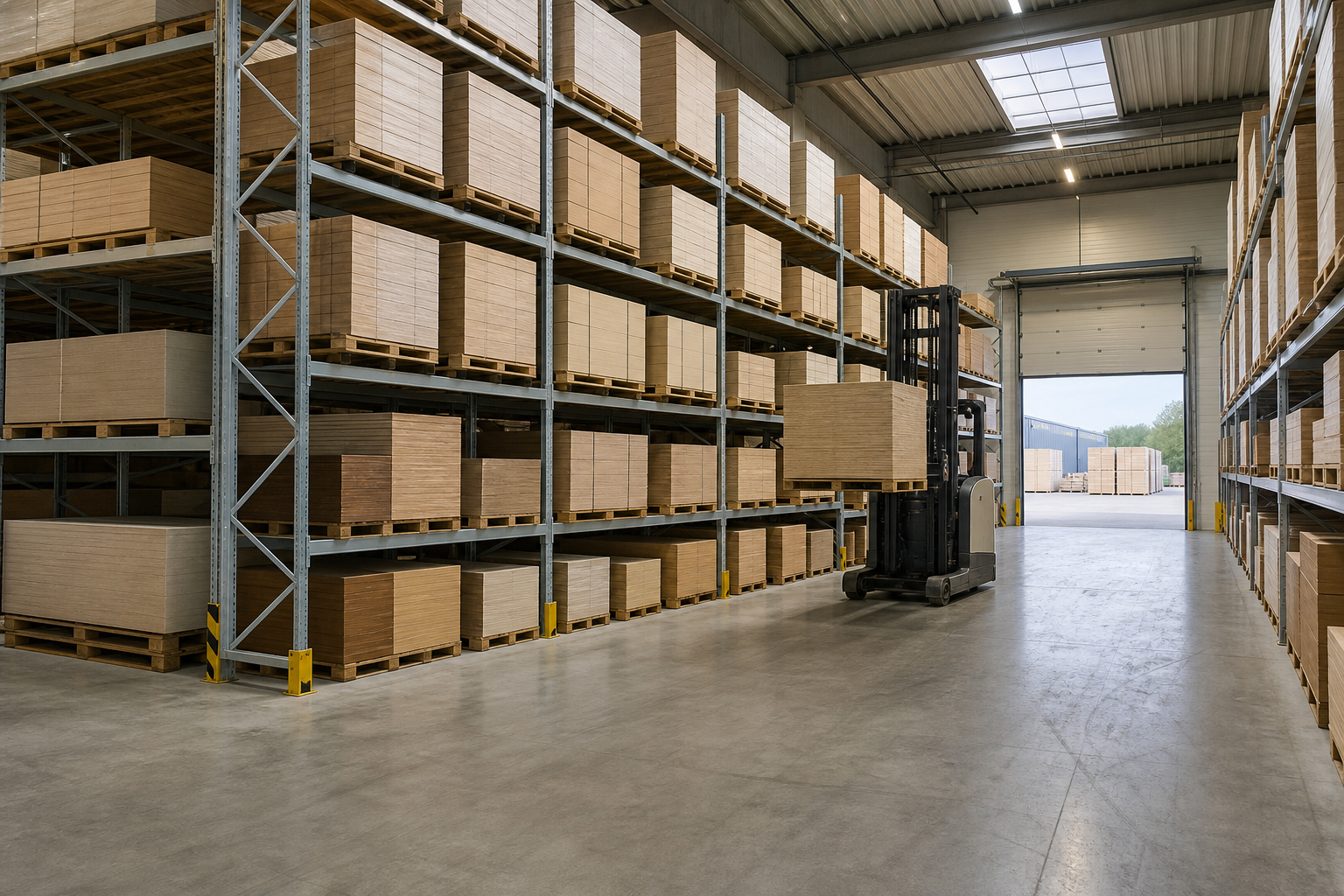
Warehouse capacity constraints and truck shortages are common during peak season. The distributor completed seasonal warehouse planning in early July:
Warehouse Planning:
- Moved fast-moving SKUs closer to shipping areas to reduce picking time during peak season
- Reserved 20% of warehouse space as a "peak-season dedicated zone" for early-arriving inventory
- Cleared slow-moving inventory to free up warehouse space
Logistics Planning:
- Secured September shipping slots with a long-term freight forwarder
- Accounted for Los Angeles port congestion, building in a 3-5 day buffer
- Pre-booked local trucking for arrivals to avoid demurrage charges
Conclusion
A successful peak-season procurement is essentially a strategic shift from reactive response to proactive planning.
By following the four-step approach—locking capacity in advance, standardizing product selection, rigorous sample confirmation, and pre-planning warehouse and logistics—the distributor reduced peak-season cost increases from 15-20% to just 5%, shortened procurement cycle by 15-30 days, and improved inventory turnover efficiency by 50%.
For B2B buyers of PVC wall panels, this case study provides a practical framework: Success in peak-season procurement depends not on what you do during peak season itself, but on how well you prepare before it arrives.
About Naturewing: As a manufacturer with over 10 years of experience in WPC and PVC panel production, Naturewing offers peak-season capacity reservation, in-stock standard specifications, 15-25 day lead times, and complete sample confirmation processes with batch traceability documentation. For more information on peak-season sourcing solutions or to reserve production capacity, please contact us.