 EN
EN

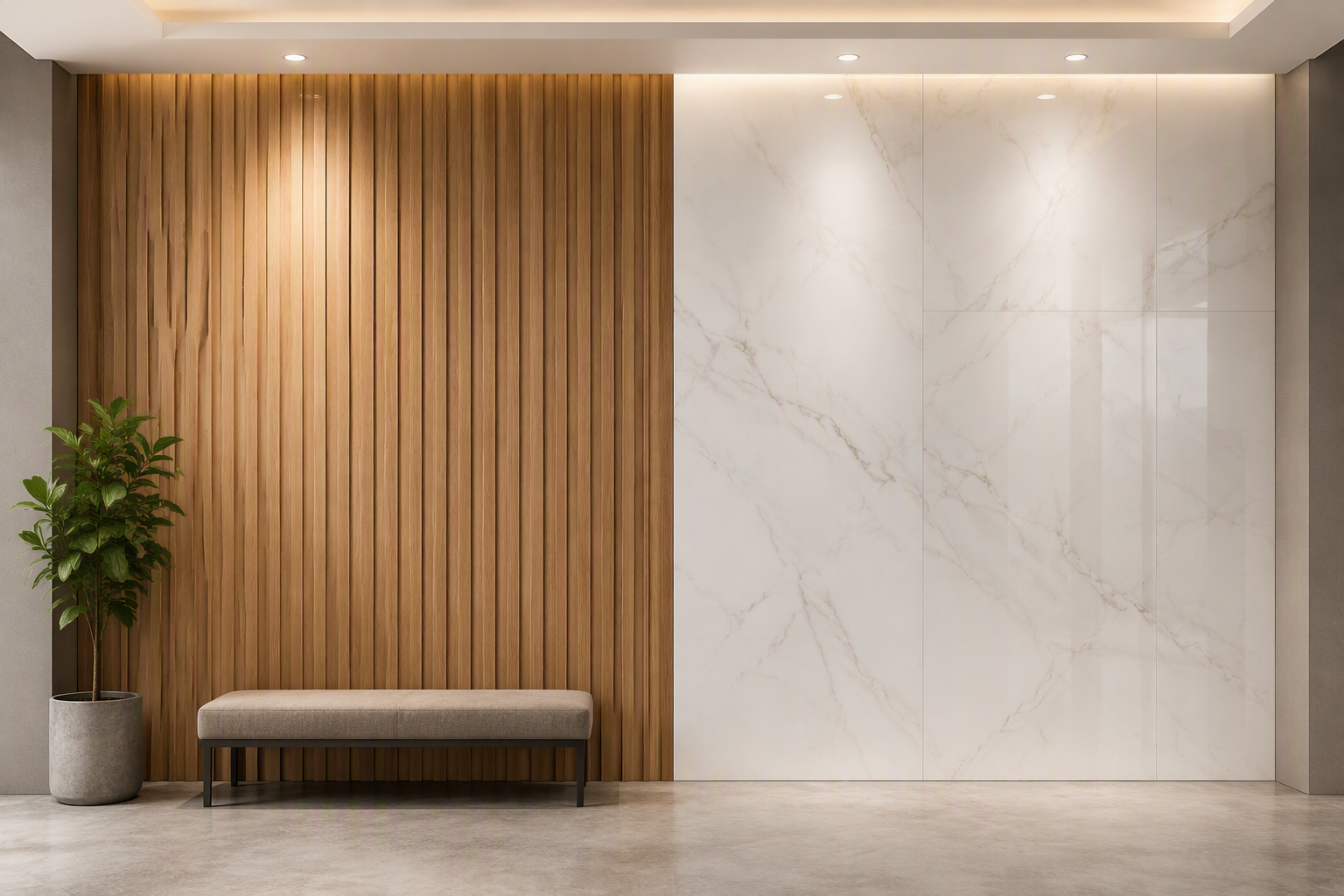
Specifiers ask the same question in every country: wpc wall panels vs pvc wall panels — which do I install where? The short answer: both, in different rooms. WPC (wood plastic composite) and PVC panels share the same installation logic but have different engineering personalities. This guide compares them on fire safety, moisture, acoustics, aesthetics and cost, then maps each material to the rooms where it performs best.
Material Basics: What Each Panel Is Made Of
|
Property |
WPC Wall Panels |
PVC Wall Panels |
|
Core material |
Wood fiber + thermoplastic + additives |
PVC resin + calcium carbonate + stabilizers |
|
Typical density |
1.2–1.4 g/cm³ |
1.4–1.7 g/cm³ |
|
Surface |
Embossed wood grain, fluted, veneer look |
Smooth, marble, 3D, metallic finishes |
|
Standard sizes |
Panel & slat formats |
Panel & large-format sheet |
|
Typical thickness |
8–18 mm |
4–10 mm |
Fire Resistance
This is the headline difference. WPC panels are commonly engineered to B1 / Class B-s1,d0 with fire-retardant additives — the rating commercial codes in the EU and North America require for corridors, lobbies and escape routes. Standard PVC panels achieve Class B2 / C-s1,d0 more typically, though fire-retardant PVC grades exist. For commercial projects, fire resistant wall panels with documented B1 certification are effectively mandatory; WPC meets that bar at competitive cost.
Moisture & Wet Areas
PVC wins here, clearly. A solid PVC panel is 100% waterproof, dimensionally stable in steam and humidity, and wipes clean — the ideal material for bathrooms, showers, kitchens and laundry areas. WPC is moisture-resistant and suitable for normal interiors, but its wood-fiber core means it should not be specified for continuously wet zones or direct steam exposure. Rule: wet areas → PVC; living and commercial spaces → WPC.
Acoustics, Impact & Comfort
The wood-fiber core of WPC absorbs more sound than solid PVC, which is why WPC is increasingly chosen for hotel corridors, offices and media rooms. WPC also handles impacts better — a luggage trolley that dents a thin PVC panel usually bounces off a thicker WPC board. Underfoot and visually, the WPC surface feels warmer and more natural; PVC reads cooler and glossier.
Aesthetics: Two Different Design Languages
WPC speaks wood: deep-embossed grain, fluted slat walls, veneer-style finishes that mimic oak, walnut and teak. It is the current favorite for feature walls, headboards and lobby cladding. PVC speaks color and pattern: marble sheets, metallic gold and silver 3D panels, glossy solid colors. If the design calls for wood, choose a wood grain wall panel in WPC; if it calls for stone or gloss, PVC delivers it at lower cost.
Cost Comparison
|
Factor |
WPC Wall Panels |
PVC Wall Panels |
|
Material price |
Higher |
Lower |
|
Installation cost |
Similar (same fixing systems) |
Similar |
|
Fire-rated grades |
Standard (B1) |
Premium option (FR-PVC) |
|
Lifespan indoors |
15–25 years |
10–20 years |
|
Typical use |
Commercial, feature walls |
Wet areas, budget projects |
Decision Matrix: Which Panel Goes Where
|
Application |
Recommendation |
Why |
|
Bathroom / shower / kitchen |
PVC |
100% waterproof, steam-proof, easy to clean |
|
Hotel corridor / lobby |
WPC (B1) |
Fire rating + impact + acoustic performance |
|
Office feature wall |
WPC fluted |
Wood aesthetics, sound absorption |
|
Living room feature wall |
WPC wood grain |
Premium look, warm feel |
|
High-moisture commercial (pool, spa) |
PVC |
Humidity resistance |
|
Budget residential |
PVC |
Lowest installed cost |
Installation & Maintenance: More Alike Than Different
Installation is where the wpc wall panels vs pvc wall panels debate mostly disappears: both use the same adhesive or furring-strip methods, the same trims and the same cutting tools, and both are manageable for a competent contractor. Maintenance is similarly light — both wipe clean with a damp cloth and need no painting. The practical differences are thin panel vs thick: PVC's thinner, lighter boards are easier for one person to handle; WPC's heavier boards feel more solid and hide wall imperfections better. For rooms where the wall gets knocked — corridors, playrooms — the thicker panel wins; for budget speed, the thinner panel does. Neither material needs the seasonal care that timber cladding demands, which is why both keep taking share from paint-and-paper finishes in renovation budgets.
Buying from a wall panel supplier who manufactures both materials has a practical advantage: one factory can quote the whole project, match the two lines aesthetically, and provide one documentation set. That is exactly the kind of mixed-specification project where a single supplier removes coordination risk.
About Naturwing: Naturwing (Hangzhou Feihuang Industry Co., Ltd.) manufactures both WPC wall panels and PVC wall panels — so we answer the WPC vs PVC question honestly. 27+ years of extrusion experience, CE/SGS/ISO 9001 certified, factory-direct with documented test reports. Request samples.