 EN
EN

Introduction: The Decking Trilemma in 2026
The outdoor living market has evolved beyond simple timber. In 2026, architects and developers are faced with a "Trilemma": they must balance Aesthetics, Performance, and Budget. For years, the choice was between wood and "early" composites. Today, the competition has narrowed down to three high-tech contenders: Wood Plastic Composite (WPC), Cellular PVC, and Aluminum.
Each material claims to be the "ultimate" solution. However, for a B2B buyer—whether you are a procurement manager for a hotel chain or a distributor stocking your warehouse—the "best" material depends entirely on the specific project constraints. Is it a high-rise balcony in London (where fire safety is king)? A beachfront resort in the Maldives (where salt-air is the enemy)? Or a suburban residential project in the US (where budget and aesthetics rule)?
As a manufacturer with 28 years in the industry, Naturwing (Hangzhou Feihuang Industry Co., Ltd.) has seen how these materials perform over decades. This guide provides a cold, hard data-driven comparison of wpc vs pvc vs aluminum decking to help you make an informed sourcing decision.
The Comparison Matrix: A Data-Driven Decision Tool
|
Material Type |
Cost (Initial) |
Lifespan |
Best Sourcing Scenario |
Maintenance |
ROI (10-Year) |
|
WPC (Co-extrusion) |
Moderate ($) |
20 - 30 Years |
Residential, Hotels, Parks |
Low (Wash only) |
High (Balanced TCO) |
|
Cellular PVC |
High ($$) |
25 - 40 Years |
Pool decks, High-moisture |
Low (Wash only) |
Medium (High entry cost) |
|
Aluminum |
Premium ($$$) |
40 - 50+ Years |
High-rise balconies, Fire zones |
Very Low |
High (Zero replacement) |
|
Traditional Timber |
Low ($ - Variable) |
5 - 12 Years |
Temporary projects, Low-budget |
High (Oil/Sand/Paint) |
Low (High maintenance) |
1. WPC (Wood Plastic Composite): The All-Rounder
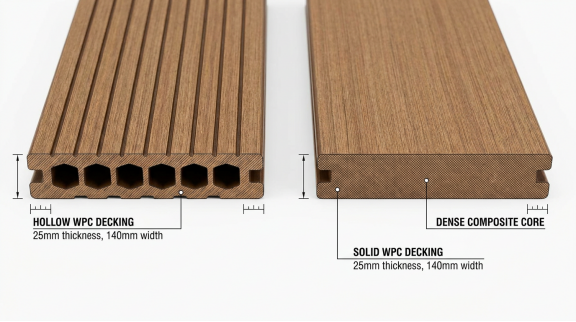
WPC remains the global market leader for a reason: it offers the best "Wood-to-Value" ratio. Modern co-extrusion (Gen-3) WPC, like we produce at Naturwing, features a PE shield that protects the wood-fiber core from the elements.
- Pros: Most realistic wood appearance, excellent slip resistance (R11), moderate cost, and huge variety in colors/textures.
- Cons: Heavier than PVC or aluminum, limited by its B1 fire rating (not A1), and can retain more heat than aluminum in direct desert sun.
- Naturwing Edge: Our 40+ automated lines allow us to produce high-density (1.35g/cm³) boards that have better structural stability than the "lightweight" WPC often found in big-box retail stores.
2. Cellular PVC: The Moisture Specialist
Cellular PVC is 100% plastic (no wood fiber). It is lighter than WPC and virtually impervious to water.
- Pros: Zero organic content means zero chance of mold or rot, lighter weight makes for easier installation, and it stays slightly cooler than WPC.
- Cons: Can have a "plastic" look and feel, more expensive than WPC, and has a higher thermal expansion coefficient (it moves more as temperatures change).
- Scenario: Best for marine docks, splash zones around pools, and areas with constant standing water.
3. Aluminum: The Fire Safety Champion
Aluminum is the premium choice, especially for the high-rise and commercial sectors.
- Pros: A1 Non-combustible (perfect for high-rise fire codes), lightest weight per linear meter, zero expansion, and will literally last a lifetime.
- Cons: Highest initial cost (2x-3x more than WPC), industrial "metallic" aesthetic which many hospitality brands dislike, and can be noisy (clanging) if not installed perfectly.
- Scenario: Mandatory for balconies above 18 meters in many jurisdictions (UK, UAE) and ultra-luxury modern commercial spaces.
Honest Negative: Why WPC is NOT the Universal Solution
As a 28-year WPC manufacturer, we are honest about when you should not buy our product:
- Skyscrapers (>18m): In many countries, insurance and fire codes now mandate A1-rated materials for balconies on high-rise buildings. WPC is B1. Do not risk your project’s compliance—choose aluminum for high-rise balconies.
- Inside Saunas or Steam Rooms: Constant 100% humidity at high temperatures can eventually affect even the best co-extrusion WPC. PVC or specialized aluminum is better for these niche indoor wet-heat environments.
- Low-Budget Temporary Fixes: If you only need a deck for a 2-year pop-up event, the durability of WPC is an unnecessary expense. Use cheap, treated softwood.
The Total Cost of Ownership (TCO) Analysis
When sourcing for a B2B project, the Initial Price is a trap. You must look at the 10-Year Landed Cost:
- Timber: $2,000 (Initial) + $4,000 (10 years of oiling, sanding, and eventual replacement) = $6,000
- Naturwing WPC: $4,500 (Initial) + $200 (10 years of cleaning) = $4,700
- Aluminum: $9,000 (Initial) + $100 (10 years of cleaning) = $9,100
For most commercial and residential applications, WPC delivers the highest ROI because it eliminates maintenance without the extreme "sticker shock" of aluminum.
Why Naturwing is Your Sourcing Partner for 2026
Hangzhou Feihuang Industry Co., Ltd. (Naturwing) understands that the "Material War" isn't about one being "better"—it's about finding the right fit for your region.
- 28 Years of Data: we have test reports comparing our WPC against PVC and aluminum for UV fade, expansion, and load-bearing.
- Hybrid Solutions: We often help distributors load "WPC Decking" and "Aluminum Joists" in the same container, providing a high-performance system at a mid-range price.
- Global Compliance: Whether you need CE for Europe or ASTM for the US, our co-extrusion products are ready for immediate specification.
Frequently Asked Questions
Q1: Does WPC or PVC get hotter in the sun? Generally, WPC retains heat longer than PVC because of its density. However, dark colors in any material will get hot. We recommend lighter colors like 'Silver Grey' or 'Sandstone' for high-sun areas.
Q2: Is aluminum decking louder than WPC? Yes. Aluminum can have a "pinging" sound when walked on or when rain hits it. WPC has a "thud" sound similar to solid wood, which is why it is preferred for residential terraces.
Q3: Can I use WPC for a boat dock? Yes, but we recommend our co-extrusion line. While PVC is 100% plastic, co-extrusion WPC provides a much better slip-rating (P4/P5) which is essential for wet docks.
Q4: Which material has the best fire rating? Aluminum is A1 (non-combustible). WPC and PVC are typically B1 (flame retardant). Always check your local building codes for high-rise requirements.
Q5: What is the most environmentally friendly option? WPC wins here. It uses 60% recycled wood fiber and 30% recycled plastic. Aluminum is recyclable but has a very high energy cost during initial production.