 EN
EN
Introduction
In the global building materials market, the difference between a successful distributor and one struggling with warranty claims often comes down to their choice of wpc wall panel manufacturer. As demand for sustainable, easy-to-install, and moisture-proof interior and exterior wall solutions skyrockets in 2026, many "new" players have entered the manufacturing space. However, volume does not equal quality, and price does not equal value.
At Hangzhou Feihuang Industry Co., Ltd. (Naturwing), we have spent nearly three decades—specifically since 1998—navigating the complexities of wood-plastic composite (WPC) science. From our humble beginnings to our current 40+ automated production lines, our journey has been defined by one goal: building quality at scale. This article pulls back the curtain on how a Tier-1 WPC manufacturer operates, providing importers and wholesalers with the technical criteria needed to vet their supply chain partners.
1. The Anatomy of a Tier-1 WPC Factory
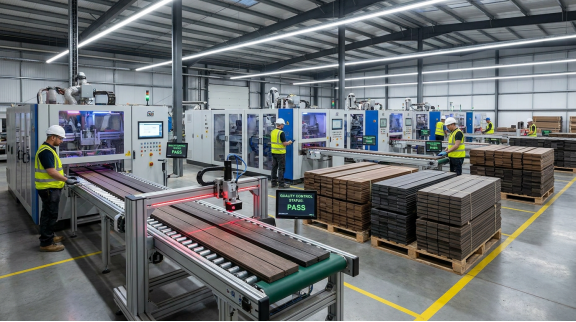
A truly professional wpc wall panel manufacturer isn't just an assembly plant; it's a chemical and mechanical engineering hub. A factory audit of our 28-year facility reveals a structure designed for consistency:
· Raw Material Storage: Controlled environments for wood fiber (bamboo/pine) and HDPE resins to ensure moisture levels remain below 1%.
· The Mixing Department: Where high-speed mixers blend wood fiber, polymer, and additives (UV stabilizers, lubricants, coupling agents) into a homogeneous "dough."
· The Extrusion Floor: 40+ twin-screw extruders, each capable of producing 2-3 tons of WPC per day with precision tolerance of ±0.5mm.
· Surface Treatment Zone: Specialized lines for 3D embossing, sanding, lamination, and co-extrusion capping.
· QA Laboratory: Equipped with spectrophotometers, moisture testers, and modulus of rupture (MOR) testing machines.
Operating at this scale allows us to maintain a Low MOQ (100㎡) while offering the competitive pricing that only a high-volume factory can sustain.
2. Raw Material Sourcing: The Foundation of Quality
You cannot produce a premium wall panel with sub-par raw materials. While many manufacturers use "recycled" materials, the source of that recycle is paramount.
We use a specific ratio: 60% reclaimed wood fiber (processed to 80-100 mesh for optimal bonding), 30% Grade A recycled HDPE, and 10% premium additives. Many factories cut costs by using "off-grade" polymers or agricultural waste like rice husks, which results in a brittle product that fails under impact testing. At Naturwing, our wood fiber is sourced from sustainable forestry waste in the Zhejiang region, ensuring a consistent density of 1.30-1.40 g/cm³ in our finished panels.
3. Precision Extrusion: Why 40+ Lines Matter
In the WPC industry, "lines" are a proxy for both capacity and specialization. Having 40+ automated production lines doesn't just mean we can ship 200 containers a month; it means we can dedicate specific lines to specific formulas.
|
Production Metric |
Naturwing Standard |
Industry Average (Small Factory) |
|
Extrusion Speed |
0.8 - 1.2 m / min |
1.5 - 2.0 m / min (Over-speeding causes voids) |
|
Temperature Control |
± 1°C precision |
± 5-10°C (Causes color variation) |
|
Cooling Tank Length |
8 - 12 meters |
4 - 6 meters (Causes internal stress/warping) |
|
Daily Capacity |
80 - 100 Tons |
5 - 10 Tons |
|
Automated Cutting |
Laser-guided (±1mm) |
Manual/Mechanical (±5mm) |
By slowing down the extrusion speed and extending the cooling phase, we ensure that the internal stresses of the board are relieved. This is why Naturwing panels remain straight and true over a 25-year lifespan, whereas panels from high-speed, low-quality lines often bow within months of installation.
4. Quality Control Protocol: The 5-Step Check
A reputable wpc wall panel manufacturer must provide transparency in their QC process. At our Hangzhou facility, we implement a 5-step protocol for every export order:
1. Incoming Material Inspection: Every batch of HDPE and wood fiber is tested for moisture content and purity.
2. In-Line Sampling: Every 2 hours, a sample is pulled from the extrusion line to check for weight-per-meter and dimensional accuracy.
3. Spectrophotometer Color Check: We ensure the ΔE (color variance) remains below 1.0 between different production runs.
4. Structural Testing: We perform cross-sectional break tests to ensure the modulus of rupture (MOR) exceeds 25 MPa.
5. Pre-shipment Container Audit: A final piece-count and visual inspection before the doors of the 40'HQ container are sealed.
These protocols have allowed us to maintain an ISO 9001 certification and pass rigorous third-party audits by SGS and Intertek for over two decades.
5. OEM/ODM Capabilities & Global Compliance
For B2B buyers looking to build their own brand, the ability of a manufacturer to offer OEM/ODM services is critical. We don't just produce "standard" profiles; we are a partner in product development.
· Custom Tooling: We can develop new profile molds in-house within 14-21 days.
· Private Labeling: Custom inkjet printing on the back of boards and branded protective film/packaging.
· Compliance Support: We assist our partners in obtaining local certifications, such as SABER/SASO for Saudi Arabia, INMETRO for Brazil, and CE/EN 13501-1 for Europe.
Having exported to 100+ countries, we understand the specific "pain points" of different regions—from the high UV index of the Mexican coast to the extreme humidity of Southeast Asia.
6. Honest Negative: When is WPC NOT the Solution?
Part of being a responsible manufacturer is knowing where your product shouldn't be used. While WPC is incredibly durable, we advise against its use in the following environments:
· Commercial Kitchen Backsplashes: WPC contains wood fiber and can absorb grease over time if not properly capped (co-extruded). For high-grease environments, stainless steel or ceramic is superior.
· Saunas and Steam Rooms: While water-resistant, constant exposure to 100% humidity and 80°C temperatures will eventually cause the wood fibers to expand beyond the capacity of the polymer matrix.
· Acoustic Isolation Rooms: While WPC wall panels provide some sound dampening, they are not a professional-grade acoustic treatment. If your project requires a specific NRC (Noise Reduction Coefficient) rating above 0.8, dedicated acoustic foam or mineral wool is required.
7. Logistics: The "7-Day Fast Shipping" Advantage
In 2026, supply chain agility is a competitive advantage. Because we maintain a massive production capacity, we can offer 7-Day Fast Shipping for a selected range of our most popular "Pillar" SKUs. This allows our distributors to fulfill urgent project orders without waiting for a full 30-day production cycle.
Our proximity to the Ningbo and Shanghai ports (within 3 hours) further reduces transit times and inland freight costs. For larger orders, a typical 40'HQ container (holding approx. 7,000-8,000 linear meters of panel) is ready for vessel loading within 15-20 days of deposit.
8. Conclusion: Choosing a 28-Year Manufacturing Partner
Selecting a wpc wall panel manufacturer is a strategic decision that affects your brand's reputation for years to come. By choosing Hangzhou Feihuang Industry Co., Ltd. (Naturwing), you are not just buying a product; you are investing in 28 years of technical evolution, 40+ lines of production power, and a commitment to global excellence.
Whether you are a wholesaler in South America or a project developer in Europe, our team is ready to support your growth. [Contact us today for a factory video tour and a 2026 price list](https://www.naturwingwpc.com/contact). Let’s build the future of sustainable architecture together.
Frequently Asked Questions
Q1: What is the difference between interior and exterior WPC wall panels? Exterior panels (cladding) require a much higher concentration of UV stabilizers and often use co-extrusion technology to prevent fading and warping. Interior panels are lighter and focus more on aesthetic textures and flame retardancy (Class B1).
Q2: Can you match a specific color from a physical sample I provide? Yes. Our R&D laboratory uses spectrophotometers to analyze your sample and create a custom color masterbatch. We provide a lab-sample for your approval before full production.
Q3: Do you provide installation accessories like clips and joists? Absolutely. We provide a complete system including WPC joists (or aluminum alternatives), stainless steel clips, and matching corner trims to ensure a professional and durable finish.
Q4: Is your factory ISO 9001 certified? Yes, our Hangzhou facility has maintained ISO 9001 quality management certification for years, ensuring that every step of our manufacturing process is documented and audited.
Q5: What is the lifespan of Naturwing WPC wall panels? For interior applications, our panels are designed to last 20-30 years. For exterior co-extruded cladding, we offer a 25-year residential warranty against rot, decay, and significant color loss.