 EN
EN

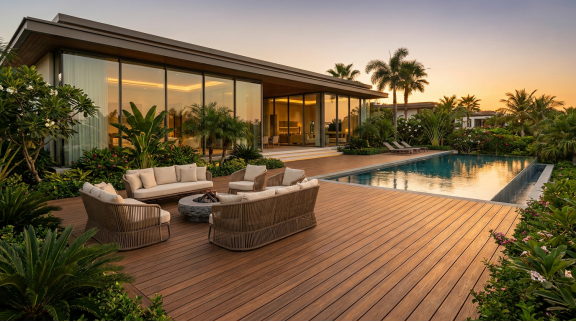
If you are sourcing WPC decking in 2026 for a hospitality project, a residential development, or for distribution into Latin America, the Middle East, or any rapidly growing outdoor-living market, the choices in front of you have multiplied — and so have the risks.
After 28 years of manufacturing wood-plastic composite (WPC) products at our Hangzhou facility — across 40+ automated extrusion lines and more than 1,000 commercial projects in 100+ countries — we have watched buyers make the same costly mistakes again and again: under-specified material formulas, mismatched climate ratings, unrealistic MOQs, and "factory" suppliers who turn out to be middlemen.
This guide is the playbook we wish every B2B WPC buyer had on day one. It is structured so a procurement manager, a project architect, or a country distributor can each pull out the section they need — and walk away with concrete sourcing decisions.
Table of Contents
- What WPC Decking Actually Is (and What It Is Not)
- Solid vs Hollow vs Co-extrusion: The Three Generations
- Performance Specs That Matter for B2B Buyers
- Climate-Fit Decision Matrix (Mexico, LatAm, Middle East)
- Cost Structure & 2026 FOB Price Benchmarks
- The 12-Question Factory Audit Checklist
- Certifications You Should Demand
- MOQ, Lead Time & Container Loading Realities
- Common Failure Modes (and How to Spec Around Them)
- Sample-to-Container Roadmap
- Frequently Asked Questions
1. What WPC Decking Actually Is (and What It Is Not)
Wood-Plastic Composite (WPC) decking is an engineered building material made by extruding a hot mixture of wood fibers (typically 50-70%), thermoplastic polymer (typically 25-40% HDPE or PP), and functional additives — UV stabilizers, coupling agents, lubricants, color masterbatch, and biocides — into structural plank profiles.
It is not the same as:
- PVC decking — which uses no wood fiber at all and is purely polymer
- "Plastic lumber" — which is recycled plastic with little or no engineered structure
- Thermally modified wood — which is real wood with no polymer content
The defining advantage of true WPC is the synergy between wood (which provides stiffness, dimensional structure, and the warm aesthetic of natural lumber) and polymer (which provides moisture resistance, dimensional stability, and machinability). When the formula is right, you get a material that visually reads as wood, performs structurally like wood, and resists rot, insects, and moisture far better than wood ever could.
|
Engineer's note: A WPC formula with less than 50% wood fiber starts to feel and behave like plastic — visually flat, prone to thermal expansion. A formula with more than 70% wood becomes water-absorbing and brittle. The 60/30/10 ratio (wood/HDPE/additives) is the industry sweet spot, and it is what we extrude on most production lines at our Hangzhou facility. |
2. Solid vs Hollow vs Co-extrusion: The Three Generations
WPC decking has evolved through three commercial generations. Knowing which generation a supplier is quoting is the single most important spec a buyer can verify.
|
Generation |
Profile Type |
Cost Index |
Lifespan |
Best For |
|
Gen 1 |
Solid uncapped |
1.0× |
8-12 years |
High-traffic commercial decks, marine boardwalks |
|
Gen 2 |
Hollow uncapped |
0.7× |
7-10 years |
Residential decks, cost-sensitive distributor lines |
|
Gen 3 |
Co-extrusion (capped) |
1.4× |
20-25 years |
Premium hospitality, beachfront, harsh-climate projects |
Co-extrusion is the modern premium standard. A second polymer layer (typically a high-density PE or PP shell with high concentration of UV stabilizers and stain blockers) is co-extruded around the WPC core in a single continuous process. This shell is typically 0.5-1.5 mm thick and provides:
- Stain resistance (against red wine, grease, sunscreen — critical for restaurant patios)
- Color-fastness 4x longer than uncapped WPC
- Scratch-resistance (typically 2H pencil hardness or better)
- Mold and algae resistance, even in tropical humidity
For any project facing UV index above 9 (most of Mexico, the Middle East, and equatorial South America) or salt spray (within 1 km of coastline), co-extrusion is not optional — it is the only economically rational choice.
Caption: A cross-section of co-extruded WPC decking, showing the three structural elements: (1) the outer co-extrusion polymer shell, (2) the wood-plastic composite core, and (3) the internal hollow chambers that reduce weight and material cost without sacrificing load capacity.
3. Performance Specs That Matter for B2B Buyers
When you receive a quotation, demand the following specs in writing — not on a marketing brochure, but on a product datasheet:
|
Spec |
Acceptable Range |
Why It Matters |
|
Density |
1.20-1.45 g/cm³ |
Below 1.20 indicates voids; above 1.45 indicates over-filled and brittle |
|
Water absorption (24h) |
≤ 0.5% |
Anything above 1% will swell and crack within 3 monsoon seasons |
|
Thermal expansion |
≤ 3.0 × 10⁻⁵ /°C |
Critical for desert and tropical day/night temperature swings |
|
Slip resistance (DCOF) |
≥ 0.42 (wet) |
Required for pool and restaurant patio installations |
|
Flame spread (ASTM E84) |
Class B (≤75) |
Mandatory for most commercial projects |
|
Color fade (ΔE after 2,000 hr Xenon arc) |
≤ 5 |
Below 5 is "not visibly faded" to the human eye |
|
Modulus of rupture (MOR) |
≥ 25 MPa |
Determines max joist span (typically 350-400 mm) |
If a supplier cannot produce a third-party test report (SGS, Intertek, TÜV) for at least the first five of the above, walk away.
4. Climate-Fit Decision Matrix
Different markets have radically different failure modes. Here is the matrix we use internally when consulting on overseas projects:
|
Region |
Primary Stressor |
Recommended Specs |
|
Mexico (Pacific coast, Cancún) |
UV + salt spray |
Co-extrusion, ΔE≤3, salt-spray tested 1,000h |
|
Brazil, Colombia tropical |
High humidity + UV |
Co-extrusion, water absorption ≤0.3%, mold-tested |
|
Saudi Arabia, UAE deserts |
Extreme heat + sandstorm |
Heat-resistant formula (75°C tested), B1 fire rating |
|
Andean highland (Peru, Chile) |
High UV at altitude + freeze-thaw |
Co-extrusion, freeze-thaw cycle tested ≥50 cycles |
|
Caribbean |
Hurricane wind + saline |
Heavy hidden fastener system, structural-grade solid |
A WPC product that performs perfectly in Northern Europe will often fail within two years on a Cancún beach. Climate-specific formulation is the difference between a 5-year warranty claim and a 20-year referenceable project.
5. Cost Structure & 2026 FOB Price Benchmarks
Transparent FOB China pricing for the three generations, in USD per linear meter (138 mm width × 23 mm thickness, the most common B2B spec):
|
Type |
FOB Price (USD / m) |
Typical Lead Time |
|
Solid Gen-1 (uncapped) |
$2.20 - $3.50 |
15-25 days |
|
Hollow Gen-2 (uncapped) |
$1.80 - $2.80 |
7-15 days |
|
Co-extrusion Gen-3 |
$3.80 - $6.50 |
20-30 days |
Pricing variation comes mostly from: (1) wood-fiber type (bamboo > pine > rice husk), (2) HDPE source (virgin > recycled), (3) color complexity (3D wood grain > solid color), and (4) order volume tier breaks (typically at 1×20'GP, 1×40'HQ, and 5×40'HQ).
6. The 12-Question Factory Audit Checklist
Before you place a sample order — let alone a container — ask these 12 questions and require documented answers:
- Are you a manufacturer or trading company? (Request business license + factory video call.)
- How many extrusion lines do you operate, and what brand are they? (Italian/German extruders signal quality.)
- What is the wood-fiber source and ratio in your standard formula?
- Do you produce solid, hollow, and co-extrusion in-house, or do you OEM the co-extrusion line?
- Show me your last 3 SGS / Intertek test reports — dated within 12 months.
- What is your true MOQ, and is there a sample-to-container roadmap?
- Can I see 5 reference projects in my target country with photos and contact info?
- What is your QC inspection rate (per-piece, per-batch, sampling)?
- What is your defect-rate refund policy in writing?
- Can you provide an FCL container loading plan with piece counts?
- Do you support OEM color, length, branded packaging, and from what MOQ?
- Who is the project manager assigned to my account, and what is their direct WhatsApp?
7. Certifications You Should Demand
|
Certificate |
What It Proves |
Required For |
|
ASTM E84 |
Flame spread classification |
US, LatAm commercial projects |
|
CE EN-15534 |
EU material conformity |
All EU + many MENA countries |
|
SGS |
Independent material composition |
All B2B distributor channels |
|
ISO 9001 |
Manufacturer quality system |
Demonstrates process reliability |
|
B1 Fire Rating (DIN 4102) |
Fire-retardant performance |
Hospitality, public buildings |
|
CARB Phase 2 / FSC |
Environmental compliance |
Premium / sustainable specifications |
|
SASO / SABER |
Saudi market entry |
Required for KSA imports |
|
INMETRO |
Brazilian market entry |
Required for Brazil B2B |
8. MOQ, Lead Time & Container Loading Realities
For new distributor relationships we typically structure orders in three steps:
- Sample order: 50-100 m, ships in 7 days (DHL/FedEx air)
- Trial container: 1 × 20'GP (~3,500 m), 15-25 day production, supports 2-3 SKUs
- Bulk container: 1 × 40'HQ (~7,800 m), 20-30 days, full SKU mix
A 40' HQ container holds approximately:
- 7,800 linear meters of 138×23 mm hollow planks, OR
- 5,200 linear meters of 138×25 mm solid planks, OR
- 6,500 linear meters of 138×23 mm co-extrusion planks
9. Common Failure Modes
Three failure modes account for ~80% of B2B warranty claims we have audited:
- Cupping & warping within 6 months — caused by under-formulated HDPE ratio (<25%) or insufficient drying time of wood fiber. Spec around it by demanding moisture content ≤ 1% in raw fiber.
- Premature color fade in tropical/desert climates — caused by low UV stabilizer dosage or absence of co-extrusion shell. Spec around it by demanding ΔE ≤ 5 after 2,000 hr Xenon arc test.
- Fastener pull-through on heavy-traffic decks — caused by insufficient density and improper joist spacing. Spec around it by requiring ≥ 1.30 g/cm³ density and ≤ 350 mm joist centers.
10. Sample-to-Container Roadmap
A realistic timeline from first email to first container at your warehouse:
- Week 1: Spec discussion, formal quotation, sample shortlist
- Week 2: Sample shipped via DHL (free for serious buyers, freight collect)
- Week 3-4: Distributor receives, in-market climate test (we recommend a 2-week outdoor exposure)
- Week 5: Trial order PO, 30% T/T deposit
- Week 6-9: Production, in-line QC, pre-shipment inspection
- Week 10: FOB Ningbo / Shanghai loading
- Week 12-16: Sea freight (LatAm 28-35 days, MENA 18-25 days)
11. Frequently Asked Questions
Q1: Is WPC decking better than real wood for tropical climates? Yes — engineered WPC with co-extrusion shell delivers 3-5× the lifespan of even premium hardwoods like ipe in tropical conditions, with zero need for annual sealing or oiling.
Q2: Can WPC decking be used barefoot in summer sun? Light colors (teak, ash grey) reach 50-55°C in direct 35°C ambient sun — comparable to natural light wood and safe for barefoot use. Dark colors (espresso, charcoal) can reach 65-70°C and should be reserved for shaded or northern-exposure decks in hot climates.
Q3: What is the warranty on WPC decking from a reputable Chinese manufacturer? For solid Gen-1 products: 10-15 years residential, 5-7 years commercial. For co-extrusion Gen-3: 20-25 years residential, 10-15 years commercial. Always demand the warranty in writing on the commercial invoice, not just on a website.
Q4: How does WPC decking compare in cost over 10 years vs natural hardwood? Once you factor annual sealing, board replacements, and labor, WPC delivers a 40-60% lower 10-year total cost of ownership than ipe or teak in most markets — and 2-3× lower than treated pine.
Q5: Can a Chinese manufacturer ship directly to Mexican or Saudi ports? Yes — we ship FOB Ningbo / Shanghai to Manzanillo, Veracruz, Jebel Ali, Dammam, Jeddah, and Santos as standard routings. CIF and DDP terms are also available for established accounts.
Conclusion & Next Step
WPC decking has matured into a serious specification-grade material in 2026. The buyers who win — distributors who keep customers, contractors who keep warranty claims at zero — are the ones who treat sourcing as engineering, not as procurement.
If you are evaluating WPC decking for a specific project or distribution channel, request a free spec consultation and 5-color sample box. Our engineering team responds within 2 hours during business days and will route your inquiry directly to the senior product engineer for your region.